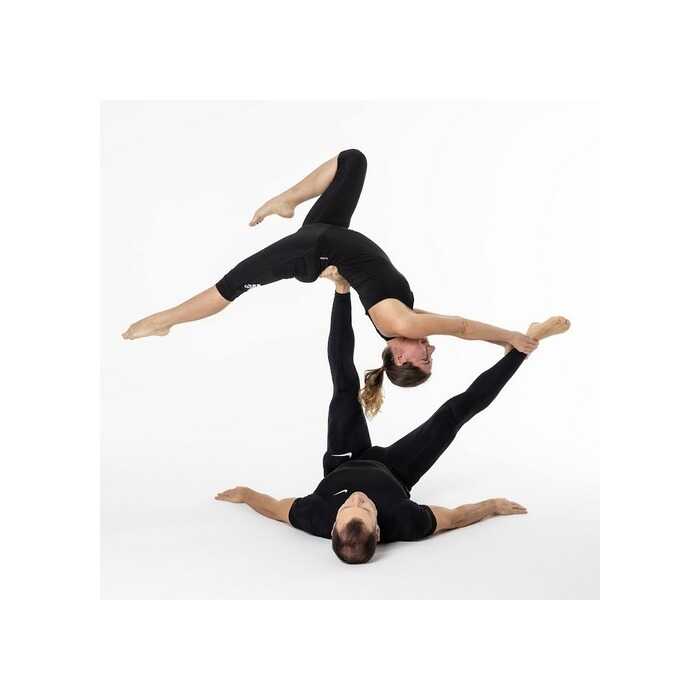
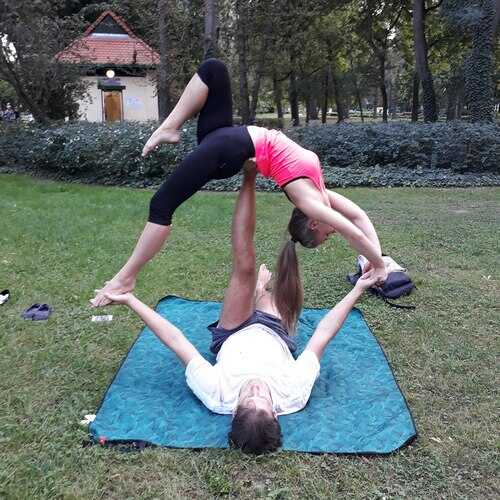
Here, the flyer is positioned perpendicular to the base, with their upper body above the base’s free leg (1.,2.) or the outer side (3.). The flyer can hold the base’s hand or the free leg, and several variations are possible.
The one-legged back bird is inside if the flyer’s upper body faces the base’s free leg. In this case, the flyer can grab the base’s other foot. It is outside if the flyer’s upper body faces outward. In the outside variation, the flyer can place their hands on the ground and transition into a handstand. Conversely, if starting from a handstand and moving into a one-legged back bird, the position will be outside.

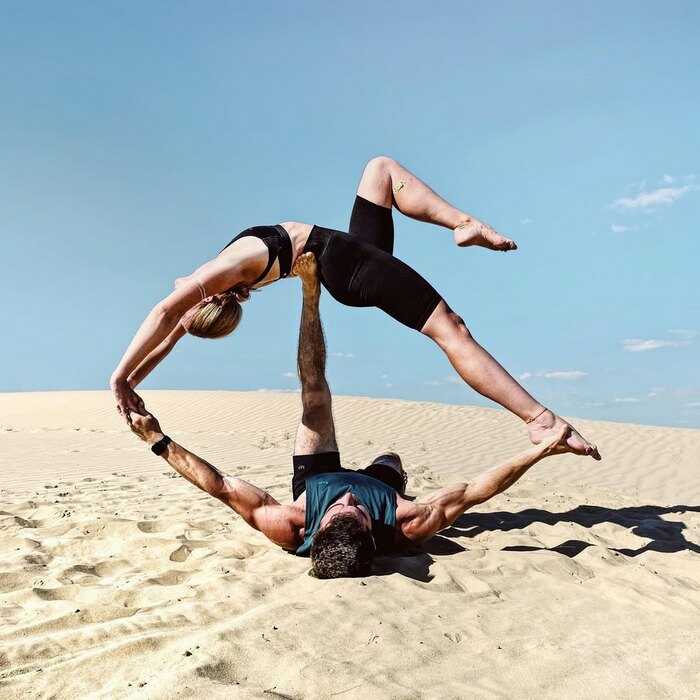

In this version, the base’s arms are on the ground, he does not hold the flyer’s leg at all, the flyer holds the base’s free leg with two outstretched hands.
Inside one-legged back bird
Kovács Tünde & Buza Gábor

The two previous one-legged back birds are each a steady, photo-able pose. In a flow however, they happen very rarely. The base sometimes holds one of the flyer’s hands, sometimes the other, sometimes neither, depending on the flow. Jacob Brown & Debbie Collis

Inside one-legged back bird withour hands.
For the video click on the image

Here, the flyer is not perpendicular to the base but positioned directly above them, parallel to their body. The base’s feet are not placed across the flyer’s sacrum but aligned with their body. Click on the image to watch the video!
Jacob Brown
Videos
In this video, the inside one-legged back bird is entered from the koala pose. We are showcasing a movement segment from a longer sequence. (mono back plank) Daniel Scott video
From Side Star, the outside One-Legged Back Bird can be entered with a tilt and rotation while the base continuously holds the flyer’s lower leg. The flyer arches back, and the base uses their other hand to catch the flyer’s hands.
Acrodemy
Kővári Janka & Deutsch Gyuri
Here, the flyer swings into the outside one-legged back bird from a handstand, and the base places their foot on the flyer’s sacrum, catching the flyer’s leg. When the weight shifts to the center, the base extends their leg and catches the flyer’s hand with theirs. Acrodemy
Kővári Janka & Deutsch Gyuri
In this beautiful video, the flyer transitions from a handstand into a back bird pose. The base holds the flyer’s shoulders throughout. In the back bird, the base extends one foot while rotating the other by 90 degrees, simultaneously rotating the flyer so that their bodies become perpendicular to each other. Inside one-legged back bird
AcroJozsi
When in Doubt, Try This First!
Back bird
Back bird “doe-legged”, i.e. the flyer draws in one leg bent and the other leg extended Flyer lets go of …
Referenced elements
From One-Legged Back Bird to Reverse Star
This AcroYoga transition moves from One-Legged Back Bird into Monolimb and then Reverse Star. The base begins by rotating the …
From One legged Back Bird to Reverse Low Foot2Hand
This AcroYoga transition moves from One-Legged Back Bird into Reverse Low Foot-to-Hand through a series of controlled movements.The base first …
From One-Legged Back Bird to Outside Star
This AcroYoga transition moves from One-Legged Back Bird into Outside Star. In the starting position, the base supports the flyer …
From One-Legged Back Bird to Reverse Inside Star
This transition is a characteristic element of the “Eucalyptus Leap” washing machine.The path forward consists of two steps: Reverse Inside …
From One-legged Back Bird to Star
This transition is very similar to the “From Back Bird to Star” transition—because, essentially, that’s exactly what it is.First, you …
From Koala Hug to One-legged Back Bird
Koala is such a cute beginner pose – it doesn’t offer too many exit routes, though. Most of the time, …
From Reverse Outside Star to One-Legged Back Bird
This elegant transition begins from the less commonly utilized reverse outside star and flows seamlessly into the visually striking one-legged …
From One-Legged Back Bird to Inside Star
This transition can be done in two different ways — let’s take a look!1. This transition is the most characteristic …
Rotisserie 3 Steps
The name “rotisserie” comes from the way the flyer rotates horizontally around their own axis – just like a rotisserie …
From Handstand to One-legged Back bird
This AcroYoga transition begins with the flyer in a handstand on the ground and finishes in a One-Legged Back Bird …