
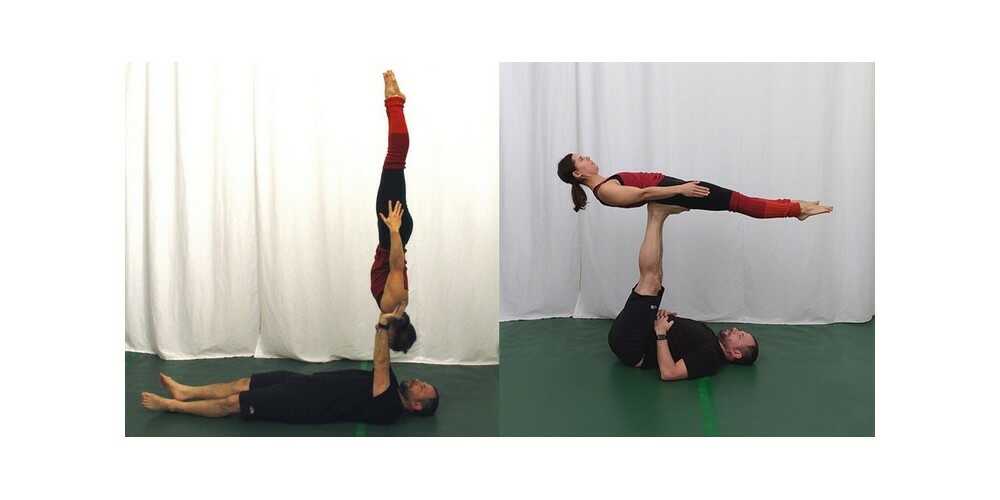
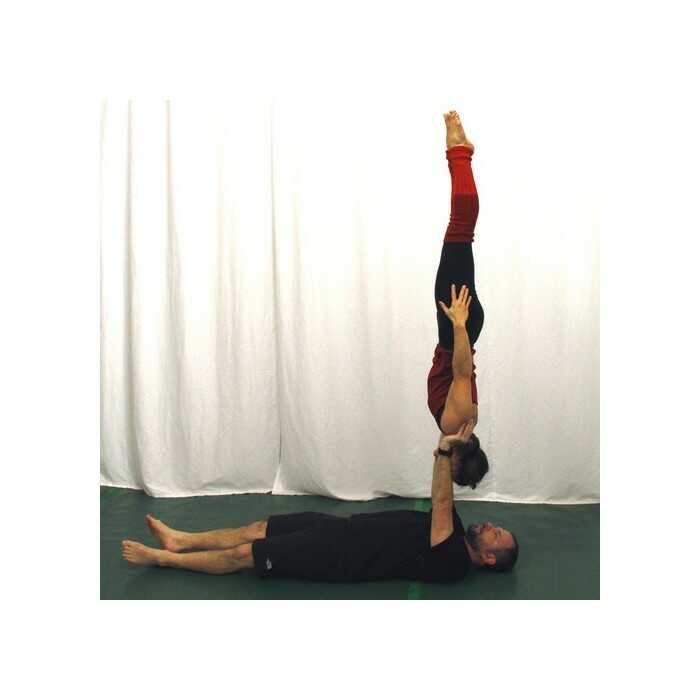
At first glance, this transition looks very similar to the familiar movement from a hand-supported Shoulder Stand into a Reverse Back Bird. The overall motion is almost identical, but one important difference changes the character of the transition.
This time, the flyer begins in a Needle instead of holding the base’s forearms. As the base gently tips her backward, he provides continuous support with his feet, allowing her to rotate smoothly into a stable Reverse Back Bird. Throughout the movement, the flyer maintains a straight, fully engaged body, relying on body tension rather than arm support.
Although the mechanics are familiar, performing the transition requires greater precision, timing, and trust between partners. Pay attention to the subtle details in the video—they make all the difference.
Used Poses
Needle : Free shoulderstand
The bird’s pose is taken by tilting, just like the ankle-hold or forearm-hold shoulderstand. The difference is that here the flyer holds her hands close …
Reverse Back Bird
A rarely used pose, actually it is only used as a transition when connecting poses. It’s very similar to the whale, which is nicer and …
Referenced Videos
Needle Catherine’s Wheel
At first glance, Needle Catherine’s Wheel looks almost identical to the classic version. The sequence, transitions, and overall flow remain …
Try it First
From Shoulderstand to Reverse back Bird
This is a complex transition that requires attention to multiple elements at once. The base initiates the movement by gradually …

