From Reverse Straddle Throne to Reverse Shoulderstand on Hands

250

A transition is often more than a single movement. The same starting and ending poses can be connected in several different ways, each with its own feel, challenge, and character.
Here you’ll find a collection of pathways and variations for this transition. Explore them, experiment with them, and discover which ones work best for you and your partner.

Original Pathway

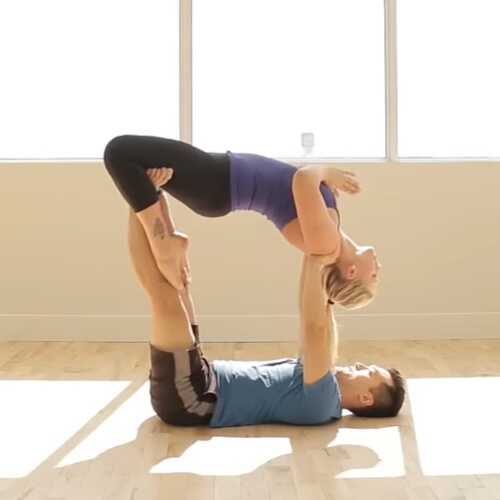
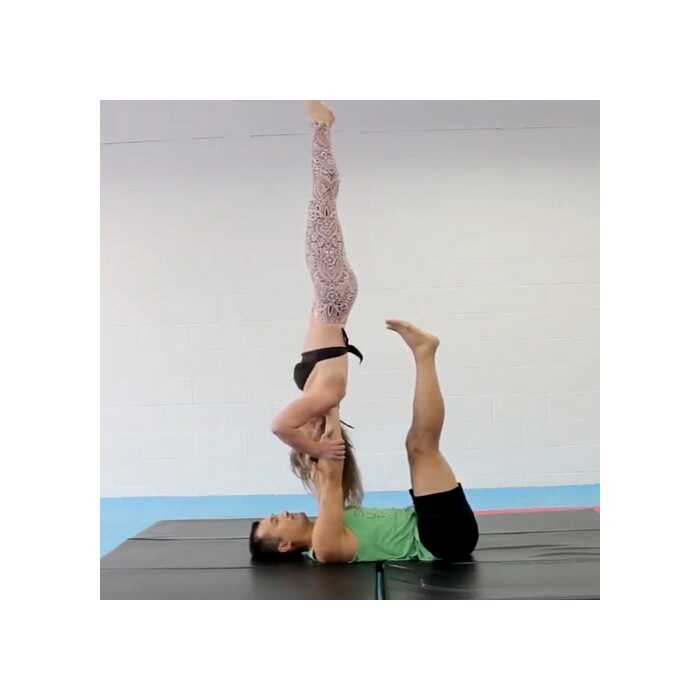
A well-known and frequently used movement, the backbend itself is called the “Waterfall.” However, from the moment the base grabs the flyer’s shoulders, the transition can continue in different ways. In this case, the flyer moves into a reverse shoulderstand—watch the video to see how it’s done!

The flyer leans back and gives her shoulder to the base. She grabs the base’s forearms, unlocks her legs, and raises them above her head to assume a shoulder stand pose.

Used poses

Transition pose

The Waterfall movement

If we look only at the part from the straddle throne to the transition pose, this movement is often called ‘the waterfall.’ In this transition, the flyer gently leans back and slides down the base’s leg, creating a flowing, downward motion that resembles a waterfall. It’s a beautiful and graceful element that’s worth practicing on its own, as part of a beginner or more advanced flow

Referenced videos

Pop pathway

Just like the original version, this pathway features a Waterfall. The difference comes at the very end, where the flyer is popped into the shoulderstand rather than arriving there through a controlled transition. It’s a small change that gives the movement a completely different feel.

From Reverse Straddle Throne to Reverse Shoulderstand with pop (includes waterfall)

Acrodemy: Vidák Andi & Bódis Józsi 

Referenced videos

Reverse Pathway

Unlike the Waterfall entry, the flyer moves forward rather than backward. She leans forward as far as possible, aiming to connect her shoulders with the base’s arms. As she commits her weight into his hands, she grips his forearms, releases the leg lock, and lifts her hips. The base assists the movement by lifting and supporting her into a stable shoulder stand.

The starting and ending poses remain the same; only the direction of the movement changes.

Referenced videos

Close
AcroDemy by Lénárt Gitta © Copyright 2025. Minden jog fenntartva.
Close