Since there are so many different side stars, we made a summary in which we collected the common features.
Side star is one of the milestones between beginner and intermediate level. If you have a stable side star, you can start learning a lot of intermediate sequences, because the side star is a connecting element in many seuences and washing machines. Thus, “side star” does not exist in itself, because there are external, internal, regular and reverse side stars. Outside-inside: indicates that the flyer’s upper body is between the two legs of the base (inside), or the upper body is facing outwards and the flyer’s legs are between the two legs of the base. In the regular side star, the flyer faces the face of the base, and in the reverse side star, the flyer has his back to the base. Each side star exists with a hand hold, a foot hold (the flyer holds the foot of the base), but also with the base holding the flyer’s foot, and free, that is, completely without hands. For each side star, the flyer can be parallel to the base and perpendicular to the base. It always depends on what kind of connection and process it is in.
The Main Types of the Side Stars
Inside Star,
Reverse Inside Star
Outside Star,
Reverse Outside Star
Inside Star
This is the most popular, simplest, and easiest to execute of the four side stars. The flyer faces the base, with their upper body positioned …
Reverse Inside Star
Base and flyer are in a perpendicular position, the flyer’s upper body is facing the base’s free leg, her face is with her back to …
Outside Star
This is a rarely used side star. The flyer’s upper body faces opposite the base’s free leg, face facing the base, so outside and face. …
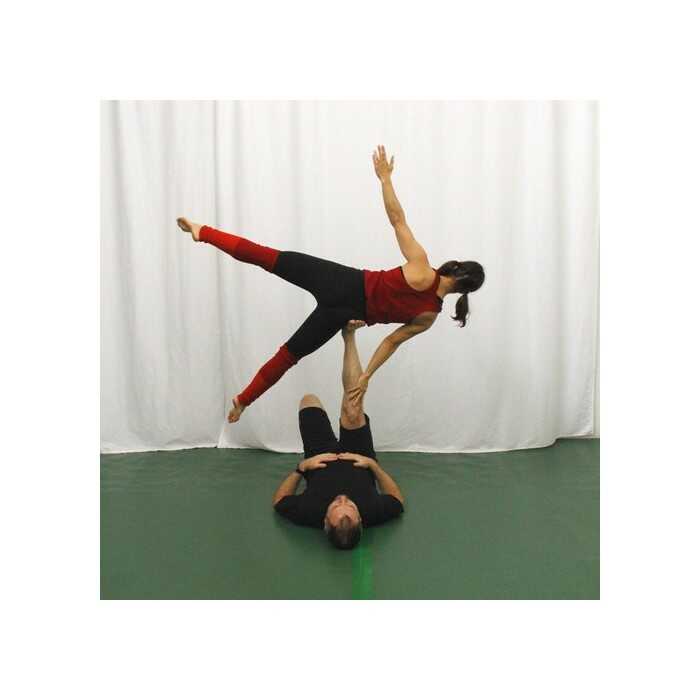
Reverse Outside Star
This is a rarely used side star. Flyer’s upper body is facing outwards, her face is with her back to the base, so outside and …
The 4 types of basic side stars were presented in such a way that in all cases the flyer is perpendicular to the base. The same positions can also be taken with the base turning its legs 90 degrees and the flyer being parallel to it. This makes it still the same side star, a small movement is the only difference. During movements, it is not always possible to separate them properly, because during movement it happens that we are somewhere between the two! Still, it’s worth looking at these poses as well. Now we only show one of the parallel versions, because the others are created in the same way, with a 90-degree rotation. This is the inside star parallel version
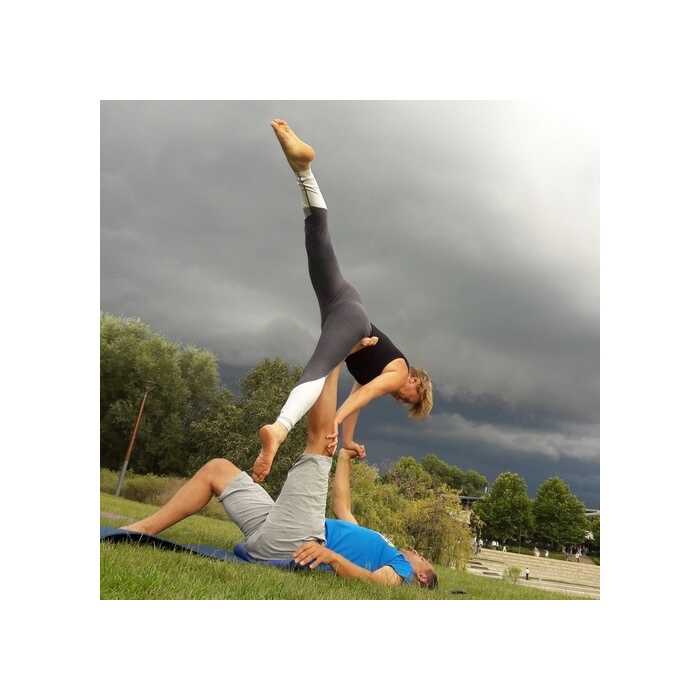
Regardless of the type of Sidestar (internal, external, parallel, etc.), the flyer’s posture should always be straight, with their legs extended symmetrically. In the picture on the left, the flyer’s upper body and legs are sagging! It’s important to have someone watch you during practice to help correct your posture—or practice in front of a mirror.
Both pictures show a Reverse OutSide Sidestar. In the first image, the flyer and base are holding hands (with both arms aligned vertically as an extension of each other), while in the second, the flyer is gripping the base’s leg.
.
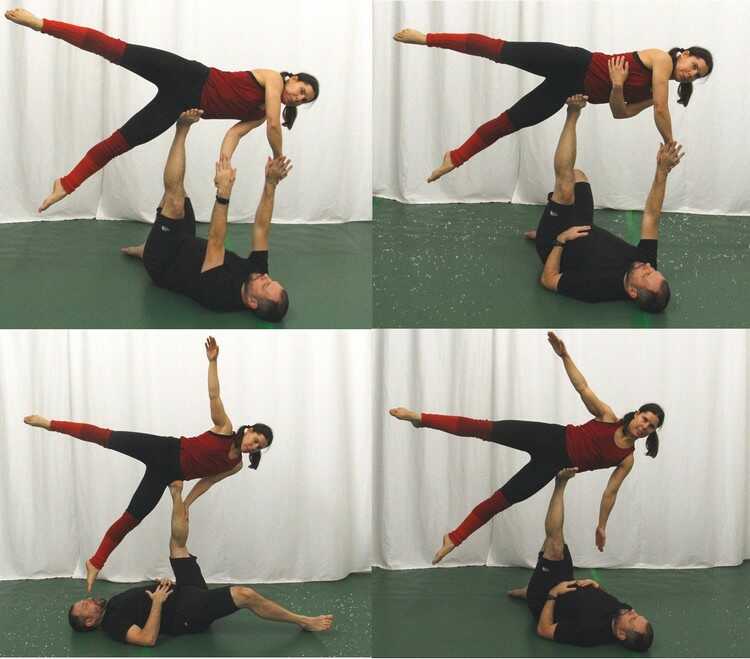
The picture shows four types of hand positions.
1. The base holds the flyer with 2 hands,
2. the base holds the flyer with 1 hand,
3. the flyer supports herself on the base’s leg,
4. and in the fourth picture there is no hand, the flyer does not hold or support anything. It is worth going through these steps, it is worth trying these poses.
Videos
Side star tutorial video with Daniel Scott
The video not only showcases different side stars but also demonstrates which side star can be reached from the four types of bird poses. Beautifully executed movements. The subtitles in the video assist with learning.
Jacob Brown
In this video, the different side stars are presented in detail, along with how to enter these poses from the ground. The subtitles in the video assist with learning. Jacob Brown
8 Side stars Jacob Brown
Let’s have fun with 5 entrances to side star !!
I – Headstand to inside star : 6”
II – Cartwheel to reverse inside star : 47”
II bis – One hand cartwheel to reverse inside star : 01′ 03”
III – Seat to inside star : 01′ 18”
IV – Handstand to inside star : 01′ 49”
V – Roll up to reverse inside star : 02′ 09”
What’s Next? This Pose!
Free Side Star
The hands-free (or Free) Side Star deserves a separate chapter. Mastering it requires strong core muscles and some technique. All …